
Latest update: 9 June 2026 - 5 min read
IRD Kilometre Rates 2025–2026: What You Need to Know
IRD has published the kilometre rates for the 2025–2026 income year. The new rates came into force on 4 June 2026 and apply to business vehicle travel in the 2025–2026 income year.
| Vehicle type | Tier 1 rate per km | Tier 2 rate per km |
| Petrol | $1.20 | 37 cents |
| Diesel | $1.30 | 38 cents |
| Petrol hybrid | $0.90 | 24 cents |
| Electric | $1.22 | 23 cents |
Tier 1 and 2 explained: Tier 1 applies to the first 14,000 kilometres of total vehicle travel in the year. Tier 2 applies to any kilometres beyond that. Read on for how the two tiers work and which rate applies to your situation.
How do the IRD kilometre rates work?
The IRD kilometre rate method lets you claim a fixed rate per kilometre for business travel, rather than tracking every fuel receipt and maintenance cost individually. You multiply your business kilometres by the applicable rate to get your deduction or reimbursement figure.
Note: The rates are split into two tiers based on total annual vehicle travel, not just business travel. That means your personal kilometres count into the total km driven in a year.
The 14,000 km threshold explained
The Tier 1 rate covers the first 14,000 kilometres your vehicle travels in the income year in total, including private travel. It’s a higher rate because it accounts for both the fixed ownership costs of your vehicle (registration, insurance, depreciation, interest) and the running costs (fuel, tyres, maintenance).
The Tier 2 rate applies to kilometres beyond 14,000. Because your fixed costs are already covered by Tier 1, Tier 2 reflects running costs only, which is why it’s lower.
Example: You drive 20,000 km in the year, of which 12,000 km is for business. Your total travel exceeds 14,000 km, so you use Tier 1 for the first 14,000 km of total travel and Tier 2 for the remaining 6,000 km, applying those rates only to the business portion of each tier.
If your total travel for the year stays under 14,000 km, you use the Tier 1 rate for all your business kilometres.
What counts as business travel?
| Business travel includes driving between work locations, visiting clients or customers, travelling to collect supplies, and other trips directly related to earning your income. Commuting, meaning travel between your home and regular place of work, does not count as business travel and cannot be claimed. |
Who can use the IRD kilometre rates?
Self-employed and sole traders
If you’re self-employed and use your private vehicle for work, you can choose between two methods for claiming vehicle expenses: the kilometre rate method or the cost method (claiming actual vehicle expenses proportional to business use).
The kilometre rate method is simpler. You don’t need to track every vehicle expense — you just need a record of your business kilometres. You claim the deduction in your income tax return for the year. For most sole traders who drive moderately for work, it’s the more practical option.
The cost method can produce a larger deduction if you have a high-cost vehicle or drive heavily for business, but it requires keeping a vehicle logbook to establish your business use percentage.
Employees using a personal vehicle
If you use your own car for work and your employer reimburses you, the IRD kilometre rates serve as a benchmark for what counts as a reasonable reimbursement. The mileage reimbursement is not considered taxable income for you as long as it’s a reasonable estimate of the costs you’ve actually incurred.
Employers are not required to reimburse at exactly the IRD rate; they can use any method that reasonably reflects your actual vehicle costs. In practice, many employers use the IRD rates as a straightforward, defensible standard.
To claim reimbursement, you’ll need to provide your employer with a record of your business trips: dates, destinations, kilometres driven, and the business purpose of each trip.
How do I calculate my deduction or reimbursement?
Multiply your business kilometres by the applicable rate for your vehicle type.
Example 1: Petrol vehicle, total travel under 14,000 km
You drive 8,000 km for business during the year. Your total vehicle travel is 9,500 km, so Tier 1 applies throughout.
8,000 km × $1.20 = $9600
Example 2: Petrol vehicle, total travel over 14,000 km
You drive 18,000 km in total during the year, of which 11,000 km is for business. Because your total travel exceeds 14,000 km, you apply Tier 1 to the business portion of the first 14,000 km, and Tier 2 to the business portion of the remaining 4,000 km.
Working out the business proportion: 11,000 ÷ 18,000 = 61.1% business use.
Tier 1 portion: 14,000 km × 61.1% × $1.20 = $10,265
Tier 2 portion: 4,000 km × 61.1% × 37 cents = $904
Total: $11,169
Note that this is just an example. For a more precise calculation based on your own business driving patterns, speak with your accountant.
IRD kilometre rates increase 2025–2026 vs 2024–2025
All rates have increased from the previous year. The electric vehicle Tier 1 rate saw the largest movement, up 14 cents from $1.08 to $1.22.
| Vehicle type | Tier 1 2025-26 | Tier 1 2024-25 | Tier 2 2025-26 | Tier 2 2024-25 |
| Petrol | $1.20 | $1.17 | 37 cents | 37 cents |
| Diesel | $1.30 | $1.26 | 38 cents | 35 cents |
| Petrol hybrid | 90 cents | 86 cents | 24 cents | 21 cents |
| Electric | $1.22 | $1.08 | 23 cents | 19 cents |
If you’re currently filing your return for the 2024–2025 income year, the 2024–2025 rates apply. Use the rates that correspond to when the travel occurred.
Do you need a vehicle logbook to use the IRD kilometre rates?
Yes. IRD requires you to keep records of your business travel at or near the time the trips occur. Reconstructing your trips from memory at year-end is not accepted.
Your records need to show:
- The date of each trip
- Where you travelled to and from
- The number of kilometres driven
- The business purpose of the trip
For employees claiming reimbursement, these records are submitted to your employer. For self-employed people, they support your tax return and must be kept in case of an IRD review.
Keeping your logbook with Driversnote
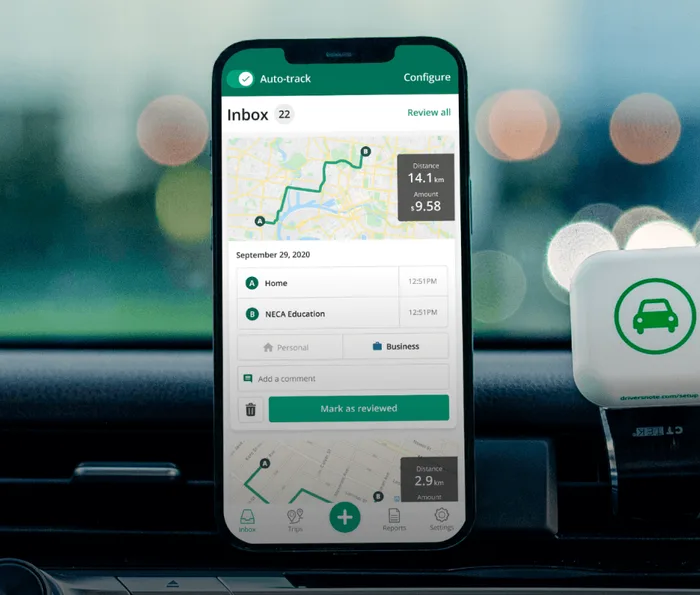
Driversnote automatic vehicle logbook app tracks your business trips automatically in the background, no manual entries needed. Every trip is logged with the date, route, and distance, and you can add a purpose with one tap. When it’s time to claim or submit for reimbursement, you generate an IRD-compliant report in seconds, without having to manually split your personal kms from business driving.
This article is for general information only and does not constitute tax advice. If you have questions about your specific situation, consult a tax professional or visit ird.govt.nz.
FAQ
The rates depend on your vehicle type. For petrol vehicles: $1.20 (Tier 1) and 37 cents (Tier 2). Diesel: $1.30 and 38 cents. Petrol hybrid: 90 cents and 24 cents. Electric: $1.22 and 23 cents. Tier 1 applies to the business portion of the first 14,000 km of total travel; Tier 2 applies beyond that.
It refers to your vehicle's total travel in the income year — private and business combined. If you travel 14,000 km or less in total, you use the Tier 1 rate for all your business kilometres. If you exceed 14,000 km, you use Tier 1 for the business portion of the first 14,000 km and Tier 2 for the rest.
Yes. Employers are not required to use the IRD kilometre rates exactly. They can reimburse at any rate that reasonably reflects the actual cost of using your vehicle for work. The IRD rates are widely used as a practical benchmark because they're updated annually and straightforward to apply.
Yes. Whether you're self-employed or an employee claiming reimbursement, you need a contemporaneous record of your business trips: date, destination, kilometres driven, and purpose. IRD does not accept estimated or reconstructed records.
Tired of logging mileage by hand?
Effortless. IRS-compliant. Liberating.
 Auto-track trips
 Classify trips
 IRS compliant reports