Latest update: 15 June 2026 - 10 min read
IRD Mileage Reimbursement Guide NZ
If you use a vehicle for work in New Zealand, you can usually claim back part of what it costs you to run it. Whether you are self-employed and claiming a tax deduction, an employee seeking reimbursement, or an employer setting up a scheme, the rules come from the same place: Inland Revenue (IRD).
This IRD mileage guide explains how it works in plain terms. In NZ, what some people call IRD mileage is officially the kilometre rate, and the two terms refer to the same thing. You claim the business portion of your vehicle costs, and you have two ways to work that out: the kilometre rate method, which uses a set rate per kilometre, or the cost method, which uses your actual expenses.
We cover the current IRD kilometre rates for the 2025–2026 income year, who can claim, how each method works, and the records IRD expects you to keep. Each section stands on its own, so you can read the whole guide or jump to the part that fits your situation.
IRD kilometre rates
IRD mileage rates, officially known as the kilometre rates, are set each year by the Commissioner of Inland Revenue. They give you a fixed amount to claim per business kilometre, so you do not have to add up every fuel receipt and repair bill to work out what your vehicle costs.
The rate is meant to cover the full cost of owning and running a vehicle for business: fuel, road user charges where they apply, tyres, servicing, insurance, registration, and depreciation. You multiply your business kilometres by the rate that applies to your vehicle, and that figure is what you can claim as a deduction or use as a reasonable basis for reimbursing an employee.
There are two tiers to the rate, and which one applies depends on how far the vehicle travels in the year rather than how far you drive for business alone.
IRD kilometre rates for the 2025–2026 income year
The rates below apply for the 2025–2026 income year and were published by IRD on 3 June 2026. The Tier 1 rates reflect an overall increase in vehicle running costs during the year.
| Vehicle type | Tier 1 rate per km | Tier 2 rate per km |
| Petrol | $1.20 | 37 cents |
| Diesel | $1.30 | 38 cents |
| Petrol hybrid | $0.90 | 24 cents |
| Electric | $1.22 | 23 cents |
You can see the full breakdown and historical context in our overview of the IRD kilometre rates 2025–2026.
How the two tiers work
The Tier 1 rate combines your vehicle’s fixed and running costs. It applies to the business portion of the first 14,000 kilometres the vehicle travels in the income year. The Tier 2 rate covers running costs only and applies to the business portion once total travel passes 14,000 kilometres.
One point catches many people out. The 14,000 kilometre threshold counts the vehicle’s total travel for the year, both business and private, not just the kilometres you drove for work. So once the vehicle has clocked 14,000 kilometres in total, your business kilometres above that point are claimed at the lower Tier 2 rate.
Two methods for claiming vehicle expenses
IRD gives you two ways to work out the business share of your vehicle costs: The kilometre rate method and the cost method. The summary below covers the main differences.
The kilometre rate method
With the kilometre rate method, you keep a record of your business kilometres and multiply them by the rate for your vehicle type. You do not need to keep receipts for fuel, servicing, or other running costs, because the rate already accounts for them. This method suits people who want a lighter record-keeping load and who drive a moderate number of business kilometres each year.
To use it, you still need to know your business-use proportion, which is where a vehicle logbook comes in.
The cost method
The cost method lets you claim the business percentage of your actual vehicle costs for the year. You add up everything it costs to own and run the vehicle, then claim the share that relates to business use. This approach takes more record-keeping, since you keep receipts for all vehicle expenses, but it can produce a larger claim if your vehicle is expensive to run or you drive a high number of business kilometres.
Working out your business use with a log book
Both methods rely on knowing how much of your driving is for business. To establish this, IRD lets you keep a vehicle logbook for a test period of at least 90 consecutive days, recording the date, distance, and business reason for each work trip, along with the odometer readings.
You then divide your business kilometres by the total kilometres travelled in the test period to get your business-use percentage. That percentage can be used for up to three years, as long as your pattern of business use does not change by more than 20 percent. If it does, you start a new 90-day log book.
Also read: IRD Vehicle Log Book Requirements
Claiming vehicle expenses when you are self-employed
If you are self-employed, a contractor, or run a small business, you can claim the business portion of your vehicle costs as a deduction on your tax return. You choose either the kilometre rate method or the cost method, and you apply your business-use percentage from your logbook.
Keep your logbook and supporting records throughout the year so you can substantiate the claim if IRD asks. You claim the deduction when you file your return, and you can do so each year you use the vehicle for business. For a step-by-step walk-through of the process, see our guide on how to claim vehicle expenses from IRD.
If your vehicle is used only for business, you can claim the full cost of owning and running it. If it does double duty for private trips as well, you claim only the business share.
Vehicle expense reimbursement for employees
If you are an employee and you use your own vehicle for work, your employer can reimburse you for the business kilometres you drive. Many employers use the IRD kilometre rates as a reasonable basis for this, since the rates are designed to estimate what running a private vehicle for business actually costs.
A reimbursement that reflects your genuine business-use costs is not treated as taxable income. If you are paid more than a reasonable estimate of those costs, the excess can be taxed as part of your pay.
Some employees receive a car allowance instead of, or alongside, a per-kilometre reimbursement. An allowance works differently and is generally treated as taxable income, so it is worth understanding how the two compare. Our guide to car allowance for employees explains what to expect and how it affects your tax.
Whatever method your employer uses, keep a consistent record of your work trips. Your employer decides exactly what they need, so check with them before you start logging.
Reimbursing employees as an employer
As an employer, you are not legally required to reimburse staff for using their own vehicles, but most do, and a clear scheme makes you a more attractive place to work. The simplest approach is to reimburse at the IRD kilometre rate, with employees submitting their business kilometres for each period.
There is an important timing point for the 2025–2026 year. IRD has noted that because the kilometre rates are based on costs from the prior period, and fuel prices have risen, the published rates may understate the current cost of running a vehicle. The 2025–2026 rates can still be used, or you can use any other method that gives a reasonable estimate of an employee’s costs. IRD has signalled it is considering further guidance for reimbursements in the 2027 income year.
You can also reimburse through a car allowance or by providing a company vehicle, and each option carries different tax and cost implications. If you are weighing these up, our comparison of a company car vs a car allowance sets out the trade-offs. If you manage several drivers, a shared system for logging and approving trips keeps reporting consistent and reduces the back-and-forth at tax time.
What records IRD expects
Whichever method you use, IRD expects accurate records kept at or near the time of each trip. For a vehicle logbook, that means recording for every business trip:
- the date of the trip
- the distance travelled
- the reason for the trip
- the odometer readings for the test period
If you use the vehicle for both business and private travel, record enough to show how you arrived at your business-use percentage. Keep your logbook and related records for seven years in case IRD requests them. For a full checklist of what a compliant log book needs to contain, see IRD vehicle log book requirements.
How to calculate your business-use percentage
If your vehicle is used for both work and private trips, you work out the business share like this. Total your business kilometres for the logbook period, then divide by the total kilometres the vehicle travelled in that period.
Say you drove 6,000 kilometres over your 90-day logbook period, and 4,500 of those were for business. Divide 4,500 by 6,000 to get 0.75, which is 75 percent. That means three-quarters of your driving was for business, so you can claim 75 percent of your vehicle costs under the cost method, or apply that percentage to your travel when using the kilometre rate method.
Under the kilometre rate method, you then multiply your business kilometres by the rate for your vehicle. For example, 4,500 business kilometres in a petrol vehicle, all within the first 14,000 kilometres of total travel, comes to 4,500 multiplied by $1.20, or $5,400.
Claiming vehicle expenses in New Zealand comes down to three things: knowing your business-use percentage, choosing the kilometre rate method or the cost method, and keeping records that stand up if IRD asks. Get those right and you can claim with confidence each year, whether you are deducting as a business or reimbursing staff.
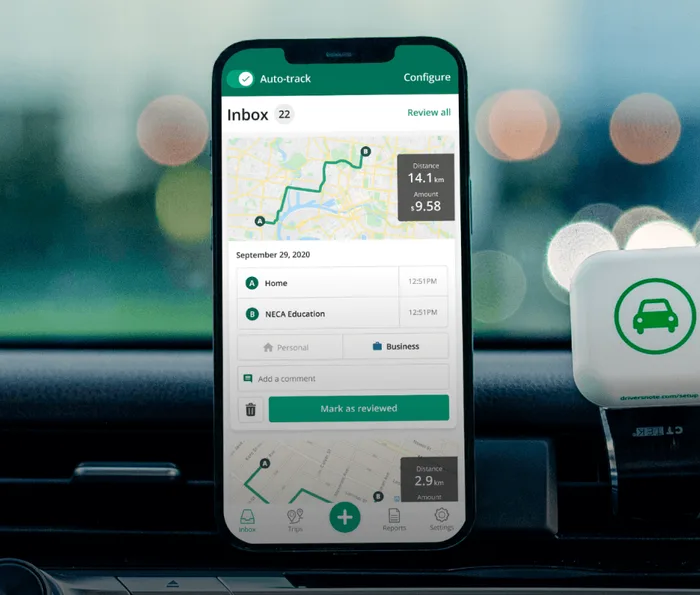
The part that takes the most effort is logging trips accurately and keeping that record for seven years. Driversnote vehicle logbook app records your trips automatically and produces IRD-ready reports you can export at tax time, so your logbook stays accurate without the manual work.
FAQ
For the 2025–2026 income year, the Tier 1 rate is $1.20 per kilometre for petrol, $1.30 for diesel, 90 cents for petrol hybrid and $1.22 for electric vehicles. The Tier 2 rate, which applies once total vehicle travel passes 14,000 kilometres in the year, is 37 cents for petrol, 38 cents for diesel, 24 cents for petrol hybrid and 23 cents for electric.
No. The 14,000 kilometre threshold counts the vehicle's total travel for the year, including both business and private trips. Once the vehicle has travelled 14,000 kilometres in total, your business kilometres beyond that point are claimed at the lower Tier 2 rate.
You keep a logbook for a test period of at least 90 consecutive days to establish your business-use percentage. That percentage can be used for up to three years, provided your business use does not change by more than 20 percent. Keep your logbook records for seven years in case IRD asks to see them.
A reimbursement that reflects your genuine business-use costs is not treated as taxable income. If you are reimbursed at more than a reasonable estimate of those costs, the amount above that estimate can be taxed as part of your income.
The kilometre rate method uses a set rate per business kilometre and does not require you to keep receipts for running costs. The cost method lets you claim the business percentage of your actual vehicle expenses, which takes more record-keeping but can produce a larger claim if your vehicle is costly to run.
Tired of logging mileage by hand?
Effortless. IRS-compliant. Liberating.
 Auto-track trips
 Classify trips
 IRS compliant reports