Latest update: 15 June 2026 - 5 min read
IRD Vehicle Log Book Requirements in New Zealand
Whether you’re self-employed or use your personal vehicle for work, IRD has clear rules about what your records need to show to claim mileage as a business deduction. A vehicle log book is the most reliable way to prove the business use of your vehicle, but a lot of drivers keep incomplete records and end up unable to claim their full expenses.
This article covers exactly what IRD requires: When you need a log book, what each entry must contain, which formats are accepted, and what the rules mean for both employees and self-employed drivers.
Who needs a vehicle log book
Not every driver needs to keep a vehicle log book, but in several common situations it’s either required or strongly in your interest.
Self-employed and sole traders
If you’re self-employed and want to claim mileage as a business deduction, IRD gives you three options: Keep a vehicle logbook, claim a flat 25% of your running costs, or add up your actual vehicle costs and claim the business portion.
The log book method is typically the most accurate, and for most people who drive regularly for work, it returns the highest deduction. If your car is predominantly used for business, the flat 25% option will almost certainly understate your actual usage. Keeping a log book lets you claim the real proportion.
If you use the per-kilometre rate method (where IRD sets a rate per kilometre rather than claiming a share of actual costs), you don’t need a full 90-day log book. You do still need a trip log showing the business kilometers you’ve driven.
Employees using a personal car for work
As an employee, you’re not required to file a log book with IRD yourself. But if your employer reimburses you for work-related travel in your own vehicle, they may ask you to keep records to support your claims.
It’s also a good idea to keep your own records regardless. If IRD ever queries your employer’s expenses or your reimbursements, having a clear record of your work trips means you’re covered. You generally want records that show the same information IRD requires for business expense claims, namely:
- The date
- Distance
- The purpose of each trip
When you don’t need a full log book
If you use your vehicle exclusively for business, with no personal use at all, IRD allows you to claim 100% of vehicle costs without keeping a log book. In practice this is rare, and IRD may ask you to justify the claim.
If your situation is straightforward and you only occasionally use your vehicle for work, the flat 25% option may be enough. It requires no log book at all, though IRD can still ask you to substantiate that figure if it queries your return.
What does IRD require you to record in your car log book?
IRD vehicle log book requirements include two things: Information about the overall log book period and a record of each individual business trip.
What to record for each trip
For every business trip, your log book needs to show:
- The date of the trip
- The distance travelled for that journey
- The reason for the trip (the business purpose)
This applies to every business trip throughout the 90-day log book period. Personal trips don’t need to be recorded in the same detail, but you do need the total distance the vehicle travelled (business and personal) to calculate your business use percentage.
The clearer your trip records, the easier it is to calculate your deduction and defend it if IRD ever asks. Vague entries like “client visit” are better than nothing, but specifics like who you visited and where you went make for stronger records.
Odometer reading requirements
For the log book itself, IRD requires your vehicle’s odometer reading at the start and end of the 90-day period. This gives you the total distance the vehicle travelled during that time, which you use to calculate the proportion driven for business.
You’re not required to record odometer readings for each individual trip – unlike some other countries’ tax rules, IRD doesn’t mandate per-trip odometer entries. That being said, your employer may have their own requirements if you’re logging trips for reimbursement purposes, so it’s worth double-checking your individual agreement.
Vehicle log book formats accepted by IRD
IRD doesn’t dictate a specific format. What matters is that your records contain the required information. So, what format is best for you?
Paper vs. digital
Paper log books, diaries, and notebooks are all acceptable. So are digital formats: Spreadsheets, CSV files, PDF exports, and Excel files all meet IRD’s requirements, provided they contain the necessary entries.
The main risk with manual records, be it paper or spreadsheet, is gaps. If you forget to log a trip at the time, it’s easy to lose track of the details later. IRD expects records to be kept close to the time of the trip, not reconstructed weeks afterwards.
Can you use an app?
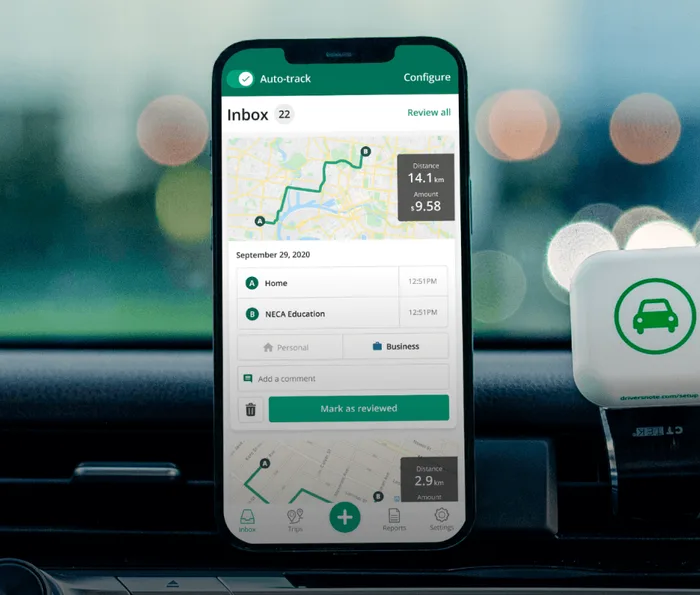
Yes. A mileage tracking app is one of the most practical ways to meet IRD’s requirements. Apps like Driversnote track trips automatically in the background, record the date, distance, and route for every journey, and let you add a business purpose with a tap. The result is an accurate, timestamped record with no manual effort.
How long do you need to keep a vehicle log book?
The log book method involves two separate timeframes: How long you run the log book, and how long your log book calculation stays valid.
The 90-day rule explained
You need to keep a log book for a minimum of 90 consecutive days. During this period, you record every business trip and use the results to calculate what percentage of your total driving is for business.
That percentage then applies to your vehicle expenses for the year, and you don’t need to run the log book again for up to three years – as long as your business use doesn’t change by more than 20%. If your situation changes significantly (you change jobs, move office, or your driving patterns shift), you’ll need a fresh 90-day log book period to establish a new percentage.
It’s worth making sure your 90-day period is representative of your typical driving. Don’t run it during an unusually busy or quiet period if your work driving varies throughout the year.
How long must you keep your mileage records?
IRD requires you to keep tax records, including mileage log books, for seven years. This applies whether your records are pen-and-paper or digital. If IRD queries a past return, you’ll need to be able to produce the log book that supported your claim.
Digital records are easiest to store long-term. If you use a mileage tracking app, check that your records are backed up or exportable, as you’ll want to be able to retrieve them years later if needed.
What happens if you don’t keep a log book?
If you haven’t kept a vehicle log book, you’re not automatically excluded from claiming mileage expenses, but your options are more limited.
The 25% fallback rule
IRD allows you to claim 25% of your vehicle’s running costs as a business expense without keeping a log book. This is the flat-rate alternative to the log book method. Running costs include petrol, Warrant of Fitness, maintenance and repairs, insurance, and parking.
The 25% figure is a concession, not a calculation – it doesn’t reflect your actual business use. For most people who drive regularly for work, their real business use is higher. You also need to be consistent. Under IRD’s vehicle expense rules, once you choose a claiming method you need to stick with it for as long as you own the vehicle. Switching between methods isn’t allowed.
If IRD audits your vehicle claims
If IRD queries your vehicle expense deductions, they can ask for your log book or other records to support the claim. Without records, it’s very difficult to justify a claim above the 25% flat rate.
IRD generally expects records to be kept at or near the time of each trip, not reconstructed from memory after the fact. A log book that was clearly filled in all at once, or that has inconsistencies, is unlikely to hold up.
Keeping a vehicle log book as an employee
As an employee you face slightly different log book considerations than self-employed drivers, because it’s usually your employer, not IRD, who sets the specific requirements for how you record your trips.
Does your employer require a log book?
Your employer may ask you to keep detailed records of work trips in your own vehicle to support reimbursement claims. The exact requirements vary by employer, but most will want to see at minimum the date, distance, and purpose of each trip.
Some employers use their own forms or systems. Others are happy with a simple spreadsheet or app export. It’s worth confirming what your employer needs before you start tracking.
Getting reimbursed at the IRD kilometre rate
The most common reimbursement method in NZ is the IRD kilometre rate. IRD sets a rate per kilometre each year, and employers can use this to reimburse employees for work-related travel in a personal vehicle tax-free up to that rate.
To claim reimbursement at the IRD rate, you need a record of the kilometres you drove for work. A trip log showing the date, distance, and purpose of each journey is the standard way to support these claims.
The IRD kilometre rate covers all vehicle running costs, like petrol, wear and tear, insurance, so you don’t need to track individual expenses separately. You just need to know how far you drove.
FAQ
Yes. If you're self-employed — a sole trader, freelancer, tradie, or consultant — you can claim vehicle expenses as a deduction against your income, as long as the travel is for business purposes. Personal travel in the same vehicle isn't deductible.
The Tier 1 rate (first 14,000 km) is $1.20 per km for petrol vehicles, $1.30 for diesel, 90 cents for petrol hybrids, and $1.22 for electric vehicles. Tier 2 rates apply beyond 14,000 km and are lower, covering running costs only.
Multiply your business kilometres by the IRD kilometre rate for your vehicle type. For example, if you drove 11,000 business kilometres in a petrol vehicle, your deduction would be 11,000 × $1.20 = $13,200. If your total annual kilometres exceed 14,000, the calculation splits across Tier 1 and Tier 2.
The kilometre rate method uses IRD's set rate per kilometre to estimate your deduction — no need to track individual expenses. The actual cost method lets you claim real running costs (fuel, WOF, insurance, depreciation), adjusted for your business-use percentage. Most sole traders use the kilometre rate method for its simplicity; the actual cost method suits people with high-cost vehicles or who want to claim GST on vehicle expenses.
Yes, IRD requires a vehicle log book to substantiate your business-use percentage. Without one, your claim is generally capped at 25% of running costs. You need to keep a logbook for at least 90 continuous days to establish your business-use proportion.
Each entry must record the date of the trip, start and end location or purpose, odometer readings at the start and end, distance travelled, and whether the trip was business or personal.
A completed 90-day log book is valid for three years, as long as your driving patterns don't change by more than 20%. If your work changes significantly, you'll need to complete a new log book.
No. Travelling from home to your regular place of work is treated as personal travel by IRD, even if you're self-employed. The exception is if you work from a home office and travel directly from there to a client or job site.
IRD can limit your vehicle expense claim to 25% of total running costs — and even that may need to be substantiated. If you're using the actual cost method, you also lose the ability to claim GST on vehicle expenses. Starting a logbook mid-year is better than having no records at all.
Only if you're using the actual cost method and are registered for GST. The kilometre rate method doesn't allow you to separately claim GST on vehicle expenses.
No — once you've chosen a method for a vehicle, you must stick with it for as long as you own that vehicle. If you're considering switching, speak with your accountant first.
IRD requires you to keep tax records, including your vehicle log book and expense receipts, for at least seven years. Digital records are accepted.
Tired of logging mileage by hand?
Effortless. IRS-compliant. Liberating.
 Auto-track trips
 Classify trips
 IRS compliant reports