Latest update: 15 June 2026 - 5 min read
Car Allowance in New Zealand: What Employees Need to Know
If your job requires you to use your own vehicle for work, your employer will typically offer either a car allowance or reimburse you per kilometre driven. Both are designed to cover the cost of using your vehicle for work — but they work differently, and IRD treats them differently for tax purposes.
Understanding the distinction matters. Depending on how your employer structures the payment, you may be paying income tax on it or receiving it tax-free. This guide explains how each arrangement works, what IRD says about the tax treatment, and how to calculate a fair reimbursement.
If you’re looking to compare car allowance benefits with company cars, read our other guide.
What is a car allowance?
A car allowance is a fixed regular payment (usually weekly, fortnightly, or monthly) paid on top of your salary to cover the costs of using your own vehicle for work. It’s intended to account for running costs like fuel, maintenance, tyres, insurance, and depreciation.
In New Zealand, you’ll also see it referred to as a vehicle allowance or motor vehicle allowance. These terms all describe the same arrangement. It’s distinct from a company car, where your employer owns the vehicle and makes it available to you, and distinct from a per-kilometre reimbursement, where you’re paid based on actual distances driven.
Employers tend to offer flat car allowances when an employee’s driving patterns are reasonably predictable — for example, a sales rep who consistently visits clients across a region each week.
How is car allowance taxed in NZ
Flat car allowance
A flat car allowance is treated as taxable income. It gets added to your salary, and PAYE is deducted on the total. You don’t receive it tax-free.
The reason comes down to how IRD defines taxable payments. A fixed allowance isn’t tied to any specific costs you’ve actually incurred, it’s a predetermined amount paid regardless of how much you drive in a given period. IRD treats it as part of your remuneration.
Per-kilometre reimbursement
A kilometre-based reimbursement works differently. According to IRD, payments that reimburse employees for actual work-related expenses are not taxable. If your employer pays you per kilometre at a rate that reflects your real costs, that reimbursement is tax-free. If the payment exceeds your actual costs, the excess becomes taxable.
IRD does allow tax-free travel allowances in certain specific circumstances — for example, if you’re required to work outside your normal hours and travel costs more than usual, or if you need to carry work equipment that makes public transport impractical. These situations are covered under IRD’s travel allowances guidance, but these are narrow exceptions, not the standard arrangement most employees encounter.
| In short: If your employer pays you a flat monthly car allowance, expect it to appear on your payslip as taxable income. If they reimburse you per kilometre at or below IRD rates, it won’t add to your tax bill. |
Car allowance vs per-kilometre reimbursement
These two arrangements are often confused, but they have meaningfully different implications for employees.
| Flat car allowance | Per-kilometre reimbursement | |
| How it’s paid | Fixed amount each pay period | Based on actual kilometres driven |
| Taxable? | Yes, treated as income | No, if paid at or below IRD rates |
| Recordkeeping | Not required from the employee | Vehicle logbook required |
| Predictability | Consistent regardless of driving | Varies with how much you drive |
| Best suited to | Consistent, predictable driving | Variable driving patterns |
From an employee’s perspective, a kilometre reimbursement is often more transparent — you’re paid for what you actually drive, and the amount is verifiable against IRD’s published rates. For employees with high and variable business driving, it can also result in a higher total payment than a fixed allowance that doesn’t reflect actual use.
The trade-off is diligent recordkeeping. To receive a per-kilometre reimbursement, you need to log your business trips accurately. A flat allowance requires no records from you, but you’ll pay tax on it.
IRD per-kilometre reimbursement rates
Employers use IRD’s published kilometre rates as the benchmark for what constitutes a reasonable tax-free reimbursement. For the 2025–2026 income year, the rates are:
| Vehicle type | Tier 1 rate per km | Tier 2 rate per km |
| Petrol | $1.20 | 37 cents |
| Diesel | $1.30 | 38 cents |
| Petrol hybrid | $0.90 | 24 cents |
| Electric | $1.22 | 23 cents |
The Tier 1 rate covers both fixed and running costs and applies to the first 14,000 kilometres driven in the year across all use, business and personal combined. The lower Tier 2 rate covers running costs only and applies once total annual kilometres exceed 14,000.
For a full breakdown of the current rates and how they’ve changed year on year, see our article on IRD kilometre rates for 2025–2026.
Example
You drive 600 km for work in a month in a petrol car. Your total annual kilometres are well under 14,000, so the Tier 1 rate applies throughout.
600 km × $1.20 = $720 tax-free reimbursement
If your employer pays above the IRD rate, say $1.50 per km, the excess of 30 cents per km ($180 in this example) would be taxable. Payments at or below the IRD rate are fully tax-free.
What records do you need to keep?
For a kilometre reimbursement, you’ll need to provide your employer with a record of your business trips. This typically means logging:
- The date of each trip
- The start and end location, or the purpose of the trip
- The distance driven
Your employer needs this to verify the reimbursement is based on actual business travel. Without a record, they can’t confirm the payment qualifies as a tax-free reimbursement rather than a taxable allowance.
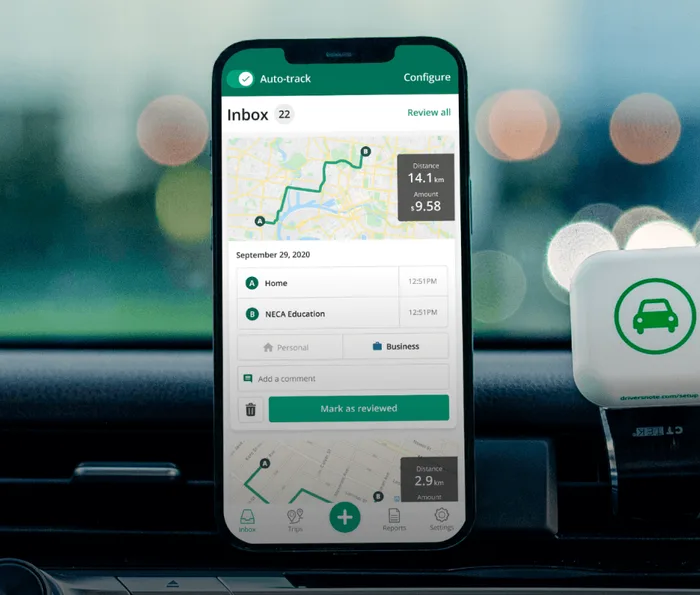
A pen-and-paper log works, though it’s easy to let slip. Many employees use a vehicle logbook app that logs each journey automatically. This produces an accurate record with little manual effort. Driversnote does this in the background and lets you export a clear trip report when you need to submit your claim.
For a flat car allowance, no recordkeeping is required from your side. The allowance is paid and taxed as part of your salary regardless of how much you drive.
FAQ
A car allowance is a fixed regular payment added to your salary to cover the costs of using your own vehicle for work. It's typically paid weekly, fortnightly, or monthly and is intended to cover running costs like fuel, maintenance, insurance, and depreciation.
Yes. A flat car allowance is treated as taxable income by IRD. PAYE is deducted on it the same way it is on your salary, because the payment isn't tied to any specific costs you've actually incurred.
A car allowance is a fixed payment regardless of how much you drive. A kilometre reimbursement is based on the actual kilometres you drive for work. The key difference is tax treatment: a flat allowance is taxable income, while a kilometre reimbursement paid at or below IRD rates is tax-free.
Yes. In New Zealand, 'vehicle allowance' and 'motor vehicle allowance' refer to the same arrangement as a car allowance. They all describe a regular payment made to employees who use their own vehicle for work.
Employers use IRD's published kilometre rates as the benchmark. For 2025-2026, the Tier 1 rate is $1.20 per km for petrol vehicles, $1.30 for diesel, 90 cents for petrol hybrids, and $1.22 for electric vehicles. You multiply your business kilometres by the applicable rate to get your reimbursement amount.
A kilometre reimbursement paid at or below IRD's published rates is tax-free, because it reimburses actual costs you've incurred. If your employer pays above the IRD rate, the excess amount is taxable.
If your employer pays above the IRD kilometre rate, the excess is taxable. IRD does not prevent employers from paying more than the published rate, but the portion above it will be treated as taxable income.
For a flat car allowance, no records are required from you as the employee. For a kilometre reimbursement, you need to provide a log of your business trips showing the date, purpose, and distance of each journey.
If you receive a flat monthly payment on top of your salary, it is a taxable car allowance. If you are paid per kilometre based on a trip log, it should be tax-free up to the IRD rate. If you are unsure, check with your employer or payroll team and ask specifically whether your payment is processed as a reimbursement or as a taxable allowance.
Tired of logging mileage by hand?
Effortless. IRS-compliant. Liberating.
 Auto-track trips
 Classify trips
 IRS compliant reports