Latest update: 15 June 2026 - 5 min read
Company Car vs Car Allowance in NZ: Which Option Saves you More in 2026?
Whether you’re negotiating a job offer or reviewing a staff benefits package, vehicle arrangements come up more often than most people expect. The choice between a company car and a car allowance in NZ affects your tax position, your day-to-day flexibility, and who ends up responsible for running costs.
Employees want to know which option puts more money in their pocket after tax. Employers want to know which costs less and creates less compliance overhead.
This guide covers the tax treatment of each arrangement, a side-by-side comparison, and practical scenarios to help both sides make an informed decision.
What’s the difference between a company car and a car allowance?
Company car
A company car is a vehicle owned or leased by the employer and made available to the employee for work purposes. The employer covers running costs including fuel, maintenance, insurance, and registration.
If the vehicle is also available for the employee’s personal use, including travel between home and work, fringe benefit tax (FBT) applies. The employer pays FBT, not the employee.
Car allowance
A car allowance is a regular payment added to an employee’s salary to cover the cost of using their own vehicle for work. The employee owns the vehicle and is responsible for all running costs. The allowance is treated as taxable income, so PAYE is deducted alongside salary. A separate arrangement, a per-kilometre reimbursement, works differently and is covered below.
How each option is taxed in New Zealand
Company cars and Fringe Benefit Tax (FBT)
FBT is a tax paid by employers on non-cash benefits provided to employees. For company vehicles, IRD requires FBT to be paid for every day the vehicle is available for an employee’s private use, even if they don’t actually use it privately on those days. Private use includes travel between home and work, unless the vehicle qualifies as a work-related vehicle with restricted personal use.
The taxable value of the benefit is calculated as a percentage of the vehicle’s cost price. For quarterly FBT filers, the rate is 5% of the vehicle’s cost price (including GST) per quarter. For employers filing annual returns, the annual equivalent is 20% of cost price.
Example
An employer provides a petrol vehicle with a cost price of $45,000 (including GST). It’s available to the employee all year.
Annual taxable value: 20% × $45,000 = $9,000
The employer then pays FBT on that $9,000 taxable value. The employee receives the benefit of the vehicle without it being added to their personal income tax liability.
For the full FBT calculation methodology, including how to factor in exempt days and employee contributions, see IRD’s guidance on calculating taxable value.
One important nuance: if the vehicle qualifies as a work-related vehicle (for example, a sign-written ute used primarily for trade work) and personal use is genuinely restricted to home-to-work travel, FBT exemptions may apply. IRD’s rules on this are specific, so it’s worth confirming with an accountant if you believe an exemption applies.
Car allowances and income tax
A flat car allowance is treated as part of the employee’s salary. It’s added to gross income, and PAYE is deducted on the total. An employee offered a $5,000 annual car allowance doesn’t receive $5,000 net; they receive whatever remains after tax at their marginal rate.
A kilometre-based reimbursement works differently. If an employer reimburses an employee at or below IRD’s published kilometre rates for 2025–2026, the reimbursement is tax-free because it’s considered a reimbursement of actual costs rather than income. If the payment exceeds the IRD rate, the excess is taxable.
For employees who drive significant distances for work, a kilometre-based reimbursement is often more tax-efficient than a flat allowance, provided their employer is willing to set up the arrangement and the employee keeps accurate trip records.
Company car vs car allowance at a glance
| Company car | Car allowance | |
| Vehicle ownership | Employer | Employee |
| Tax paid by | Employer (FBT) | Employee (income tax via PAYE) |
| Running costs | Employer | Employee |
| Personal use allowed | Often yes, subject to FBT | Yes, unrestricted |
| Vehicle choice | Employer’s decision | Employee’s choice |
| Recordkeeping | Employer tracks FBT days | Employee logs trips for km reimbursement |
| Admin complexity | Higher (FBT returns) | Lower (payroll only) |
Company car vs car allowance: Possible scenarios
High-use employee: frequent travel, client visits, regional work
For an employee covering significant distances for work each week, a company car tends to offer better overall value. Running costs are covered by the employer, the vehicle is maintained without the employee’s involvement, and there’s no out-of-pocket exposure to fluctuating fuel prices or unexpected repair bills.
From the employer’s side, FBT is a genuine cost, but it’s predictable and deductible as a business expense. For employees doing high business use, the arrangement can also reduce FBT liability if exempt days are properly documented.
A flat car allowance for this type of role can leave the employee worse off. They pay tax on the allowance, then absorb all running costs on a heavily used vehicle. The numbers rarely work in their favour unless the allowance is set generously.
Low-use employee: mostly office-based, occasional travel
For an employee who drives infrequently for work, a car allowance is often the simpler and more cost-effective arrangement for both parties. The employer avoids FBT liability on a vehicle that sits underused, and the employee retains flexibility around their own vehicle choice.
In this scenario, a kilometre-based reimbursement is worth considering over a flat allowance. The employee only gets paid for the kilometres they actually drive, but receives the reimbursement tax-free. The employer pays for actual use rather than a fixed overhead.
What employees should consider
The headline number of a car allowance rarely reflects what you’ll take home. Before accepting an arrangement, it’s worth modelling the after-tax value of the allowance against the value of having a fully covered vehicle.
For a flat allowance, consider your marginal tax rate and what you’d genuinely spend on running costs for work-related travel. If the net allowance after tax doesn’t cover your expected costs, the arrangement may not be as attractive as it appears on the offer letter.
For a company car, think about whether the vehicle on offer suits your needs. You don’t choose it, and any personal use is at your employer’s discretion. If flexibility and vehicle choice matter to you, a car allowance may suit you better regardless of the financial comparison.
If you’re reimbursed per kilometre, keeping an accurate trip log is important. A record of your business kilometres is what justifies the tax-free status of the payment. Without it, your employer can’t confidently pay you tax-free, and you have no way to verify you’re being reimbursed fairly.
What employers should consider
The true cost of a company car goes beyond the purchase or lease price. FBT compliance requires regular returns, accurate record-keeping of private use days, and an understanding of which exemptions apply. For businesses with a small number of vehicles, this is manageable; for larger fleets, it adds meaningful admin overhead.
A car allowance is simpler to administer. It’s processed through payroll, there’s no FBT return to file, and the employer’s cost is fixed and predictable. The trade-off is less control over how employees use and maintain their vehicles, and no ability to standardise the fleet.
When deciding what to offer, it’s also worth thinking about what employees in your industry typically expect. In some roles, a company car is a standard part of the package and its absence may affect your ability to attract candidates. In others, a well-structured allowance or reimbursement arrangement is perfectly normal and may be preferred.
Which option is best for you?
Neither arrangement is universally better. A company car makes most sense when driving is a substantial part of the role and the employer can absorb the FBT cost as part of a competitive package. A car allowance suits lower-use roles or employers who prefer simpler administration and predictable costs.
For employees, the key is understanding the after-tax value of what’s being offered before agreeing. For employers, the key is factoring in FBT and admin overhead alongside the headline cost of the vehicle.
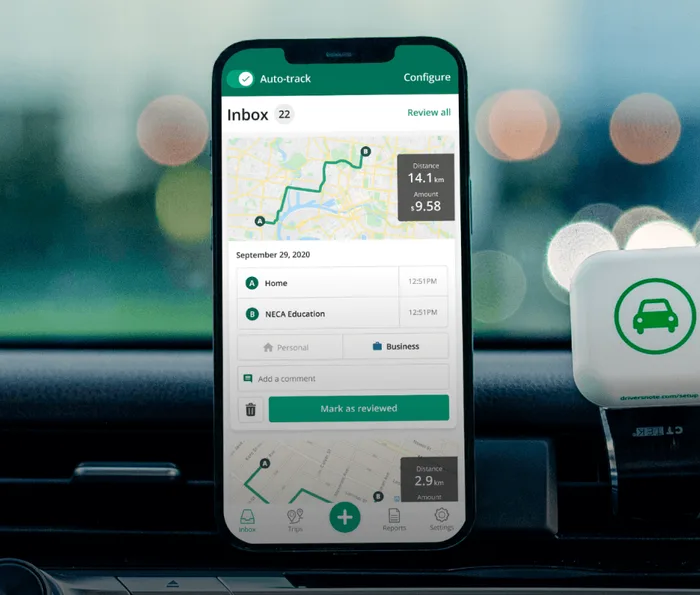
If your arrangement includes a kilometre-based reimbursement, accurate trip records are what make the tax-free treatment possible. Driversnote mileage tracking app logs business trips automatically using GPS and produces a clean report for reimbursement claims, so neither employee nor employer needs to rely on manual records.
FAQ
A company car is a vehicle owned or leased by the employer and provided to the employee for work use. A car allowance is a regular cash payment added to the employee's salary to cover the cost of using their own vehicle for work. The two are taxed differently: a company car triggers fringe benefit tax (FBT) for the employer, while a car allowance is taxable income for the employee.
Fringe benefit tax is paid by the employer, not the employee. It applies whenever a company vehicle is available for an employee's private use, including home-to-work travel. The taxable value is calculated as a percentage of the vehicle's cost price: 5% per quarter or 20% annually for employers filing annual returns.
FBT applies every day a vehicle is available for private use, even if the employee doesn't actually use it privately on those days. The only exception is if the vehicle qualifies as a work-related vehicle with genuine restrictions on personal use, in which case IRD exemptions may apply.
Yes. A flat car allowance is treated as part of your salary and PAYE is deducted on it. If your employer instead reimburses you per kilometre at or below IRD's published kilometre rates, that reimbursement is tax-free because it's considered a reimbursement of actual costs rather than income.
It depends on how much you drive for work and what the allowance covers. For high-use roles, a company car often provides better overall value because running costs are covered by the employer. For lower-use roles, a car allowance or kilometre reimbursement can be more cost-effective. The key for employees is to calculate the after-tax value of the allowance and compare it to the actual cost of running a vehicle for work.
A car allowance is generally simpler to administer because it's processed through payroll with no FBT returns required. A company car involves FBT compliance, record-keeping of private use days, and potentially managing exemptions. For employers with a small number of vehicles and employees doing substantial business travel, the company car can still make sense, but the admin overhead is higher.
Kilometre-based reimbursements paid at or below IRD's published rates are tax-free for the employee. For the 2025-2026 year, the Tier 1 rate is $1.20 per km for petrol vehicles. The employee needs to keep a trip log to support the reimbursement, and the employer uses that log to calculate the payment.
Yes. If the vehicle meets IRD's definition of a work-related vehicle and personal use is genuinely restricted to home-to-work travel necessary for employment, FBT exemptions may apply. The rules are specific, so it's worth confirming with an accountant whether your vehicles qualify.
Tired of logging mileage by hand?
Effortless. IRS-compliant. Liberating.
 Auto-track trips
 Classify trips
 IRS compliant reports