Latest update: 7 July 2026 - 5 min read
How to Claim Vehicle Expenses on Your Taxes in New Zealand: IRD Mileage Rules Explained
If you’re self-employed in New Zealand and use your vehicle for work, you can claim vehicle expenses as a tax deduction. It’s one of the most valuable deductions available to sole traders and freelancers, but it’s also one of the most commonly underclaimed or incorrectly claimed areas of tax.
IRD provides two methods for claiming vehicle expenses. The right one depends on how much you drive for work and how your vehicle is used. This guide covers who can claim, how each method works, the current IRD kilometre rates, and what records you need to keep.
Claiming vehicle expenses as a self-employed person
Self-employed people (tradies, sole traders, freelancers, consultants) can claim vehicle expenses as a deduction against their income. The condition is that the travel must be for business purposes. You can’t claim travel that’s personal, even if you use the same vehicle for work.
This guide focuses on self-employed people. Employees can also claim vehicle expenses in certain circumstances, but the rules differ. If you’re an employee using your own vehicle for work, your employer can reimburse you using IRD kilometre rates.
Business travel vs. personal travel and commute
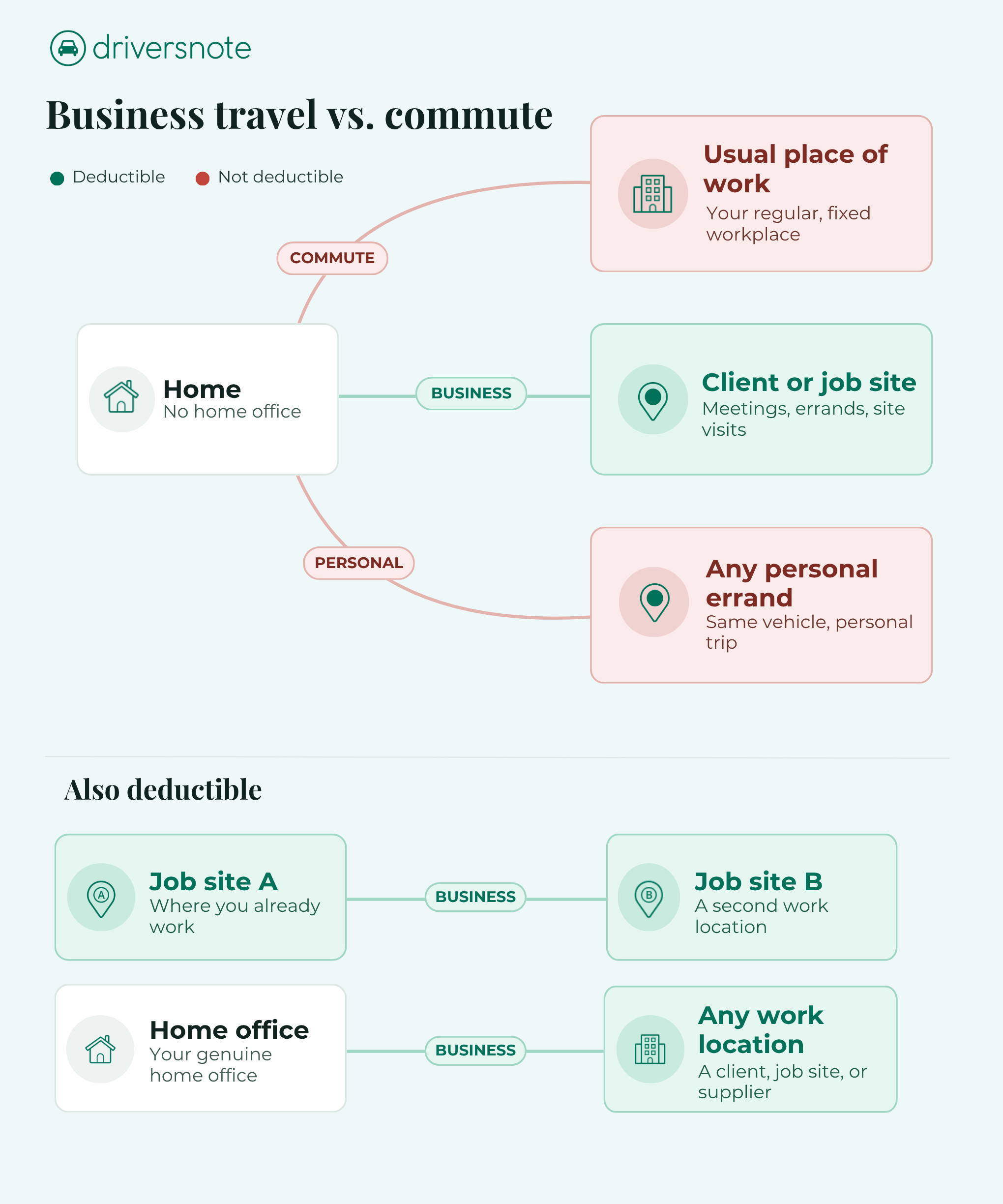
Business travel is any trip you make in the course of earning income, such as:
- Visiting a client
- Travelling to a job site
- Attending a business meeting
- Picking up supplies for a job
Your daily commute is not deductible
Travelling from home to your usual place of work is treated as a personal trip by IRD, even if you’re self-employed. The exception is if you work from a home office and travel directly from there to a client or job site; in that case, the trip can be treated as business travel.
Two methods for claiming vehicle expenses
IRD allows two methods. You need to choose one and stick with it for as long as you own that vehicle.
The IRD kilometre rate method
This is the simpler option and the most commonly used by self-employed people. Instead of tracking every running cost individually, you multiply your business kilometres by IRD’s published rate for that year. The rate is designed to cover all vehicle running costs, like fuel, maintenance, insurance, registration, and depreciation. That means you also can’t claim those separately on top.
IRD uses a two-tier system:
Tier 1 applies to the first 14,000 kilometres driven in the year (combining both business and personal travel). It covers fixed and running costs.
Tier 2 applies to any kilometres beyond 14,000. It covers running costs only, so the rate is lower.
To use this method, you need a vehicle logbook showing your business versus personal kilometres. Without one, IRD generally caps your claim at 25% of running costs — regardless of how much you actually drive for work.
The actual cost method
This method lets you claim the real costs of running your vehicle — fuel, WOF, servicing, insurance, registration, and depreciation. You apply the percentage of business use to those total costs to calculate your deduction.
For example, if your total vehicle running costs for the year are $8,000 and your logbook shows 60% business use, you can claim $4,800.
The actual cost method suits people with high-cost vehicles, heavy business use, or who want to claim GST on vehicle expenses — which the kilometre rate method doesn’t allow. It requires more detailed record-keeping: every expense receipt plus a logbook tracking your business-use percentage.
Choosing the right method
For most sole traders, the kilometre rate method is simpler and produces a reasonable result without the overhead of tracking every expense. The actual cost method tends to suit people with specialist or high-cost vehicles, or those who are GST-registered and want to claim GST on running costs.
Once you choose a method for a vehicle, you must keep using it. If you want to switch, talk to your accountant first.
The current IRD kilometre rates
IRD publishes kilometre rates each May for the tax year that ended on 31 March.
2025–2026 rates by vehicle type
| Vehicle type | Tier 1 rate per km | Tier 2 rate per km |
| Petrol | $1.20 | 37 cents |
| Diesel | $1.30 | 38 cents |
| Petrol hybrid | 90 cents | 24 cents |
| Electric | $1.22 | 23 cents |
For a full breakdown of the rates and how they’ve changed year on year, see the IRD kilometre rates for 2025–2026 on our blog.
A calculation example
Say you’re a self-employed electrician with a petrol ute. In the 2025–26 tax year, you drove 11,000 kilometres for business. Your total kilometres for the year, business and personal combined, were under 14,000 km, so all your business travel falls in Tier 1.
Calculation: 11,000 km × $1.20 = $13,200 deduction
If your total annual kilometres exceeded 14,000, the calculation would split across both tiers. Your accountant or a kilometre rate calculator can help you work that out accurately.
Keeping a vehicle logbook for IRD
What a valid 90-day logbook must include
IRD requires you to keep a logbook for at least 90 continuous days to establish your business-use percentage. Each entry needs to record:
- The date of the trip
- The start and end location (or purpose of the trip)
- The odometer readings at the start and end
- The distance travelled
- Whether the trip was business or personal
Paper logbooks work, but they’re easy to forget and difficult to maintain consistently. A GPS-based vehicle logbook app that tracks trips automatically is more reliable.
How long does a logbook last?
A completed 90-day logbook is valid for three years, provided your driving patterns don’t change significantly. IRD defines a significant change as a shift of more than 20% in your business-use proportion. If your work changes substantially, start a new logbook.
Keep a record of your odometer reading on 31 March each year. This lets you calculate your total annual kilometres and accurately split them across Tier 1 and Tier 2 if needed.
Claiming without a logbook
Without a valid logbook, IRD can limit your vehicle expense claim to 25% of your total running costs, and even that 25% isn’t guaranteed. You may still be asked to substantiate it. If you’re using the actual cost method with no logbook, you also lose the ability to claim GST on vehicle expenses.
Recordkeeping requirements
For the kilometre rate method
You need a completed 90-day vehicle logbook showing your business kilometres and business-use percentage. Keep a note of your odometer reading at 31 March each year and records showing the purpose of business trips.
You don’t need to keep fuel receipts or maintenance invoices, as the kilometre rate is designed to cover those costs.
For the actual cost method
You need your 90-day logbook plus receipts for every vehicle expense you’re claiming: fuel, servicing, WOF, registration, insurance, and any other running costs. You’ll also need records of depreciation calculations for the vehicle.
How long to keep records
IRD requires you to keep tax records for at least seven years. That applies to your vehicle logbook, expense receipts, and any supporting documentation. Digital records are accepted.
Common mistakes when claiming vehicle expenses
Treating the commute as a business trip
Travelling from home to your regular place of work is personal travel. It’s one of the most common errors IRD sees. If you’re unsure whether a particular trip qualifies, ask yourself: am I travelling to earn income, or am I getting to the place where I earn income? The second one isn’t deductible.
Claiming without adequate records
Estimating your business-use percentage without a logbook is a risk. IRD can challenge it, and without evidence you’ll likely be limited to a 25% claim. A 90-day logbook takes effort upfront but protects your claim for three years. An app that uses automatic trip tracking removes most of that effort by logging every trip in the background.
Claiming 100% on a mixed-use vehicle
If you use the same vehicle for work trips and personal trips, it’s a mixed-use vehicle. Claiming 100% of its costs as a business expense is incorrect, and it’s an area IRD pays attention to. Even if most of your driving is for work, you need a logbook to back up the proportion you’re claiming.
FAQ
Yes. If you're self-employed — a sole trader, freelancer, tradie, or consultant — you can claim vehicle expenses as a deduction against your income, as long as the travel is for business purposes. Personal travel in the same vehicle isn't deductible.
The Tier 1 rate (first 14,000 km) is $1.20 per km for petrol vehicles, $1.30 for diesel, 90 cents for petrol hybrids, and $1.22 for electric vehicles. Tier 2 rates apply beyond 14,000 km and are lower, covering running costs only.
Multiply your business kilometres by the IRD kilometre rate for your vehicle type. For example, if you drove 11,000 business kilometres in a petrol vehicle, your deduction would be 11,000 × $1.20 = $13,200. If your total annual kilometres exceed 14,000, the calculation splits across Tier 1 and Tier 2.
The kilometre rate method uses IRD's set rate per kilometre to estimate your deduction — no need to track individual expenses. The actual cost method lets you claim real running costs (fuel, WOF, insurance, depreciation), adjusted for your business-use percentage. Most sole traders use the kilometre rate method for its simplicity; the actual cost method suits people with high-cost vehicles or who want to claim GST on vehicle expenses.
Yes, IRD requires a vehicle logbook to substantiate your business-use percentage. Without one, your claim is generally capped at 25% of running costs. You need to keep a logbook for at least 90 continuous days to establish your business-use proportion.
Each entry must record the date of the trip, start and end location or purpose, odometer readings at the start and end, distance travelled, and whether the trip was business or personal.
A completed 90-day logbook is valid for three years, as long as your driving patterns don't change by more than 20%. If your work changes significantly, you'll need to complete a new logbook.
No. Travelling from home to your regular place of work is treated as personal travel by IRD, even if you're self-employed. The exception is if you work from a home office and travel directly from there to a client or job site.
IRD can limit your vehicle expense claim to 25% of total running costs — and even that may need to be substantiated. If you're using the actual cost method, you also lose the ability to claim GST on vehicle expenses. Starting a logbook mid-year is better than having no records at all.
Only if you're using the actual cost method and are registered for GST. The kilometre rate method doesn't allow you to separately claim GST on vehicle expenses.
No — once you've chosen a method for a vehicle, you must stick with it for as long as you own that vehicle. If you're considering switching, speak with your accountant first.
IRD requires you to keep tax records, including your vehicle logbook and expense receipts, for at least seven years. Digital records are accepted.
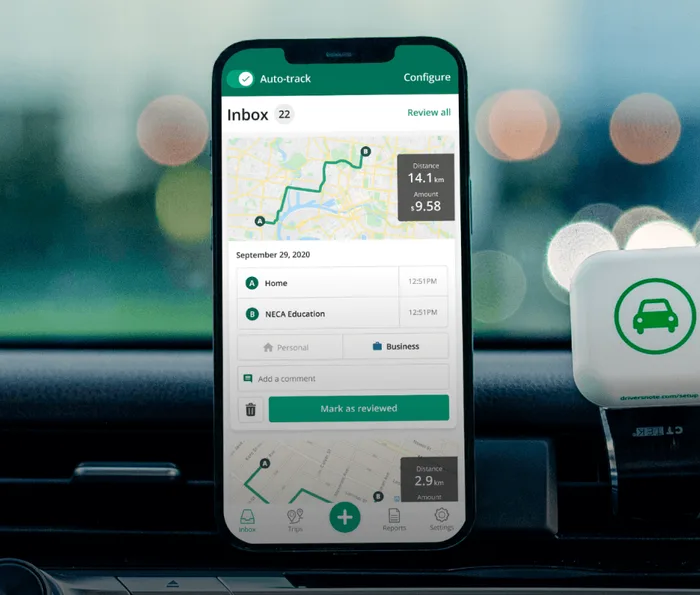
Tired of logging mileage by hand?
Effortless. IRS-compliant. Liberating.
 Auto-track trips
 Classify trips
 IRS compliant reports