Latest update: 4 August 2026 - 5 min read
Free Mileage Calculator NZ: Work Out Your IRD Kilometre Claim (2025–2026)
Want to know what your business driving is worth? Our free mileage calculator for NZ turns your business kilometres into an estimated IRD deduction or reimbursement in seconds. Choose your vehicle type and income year, enter your kilometres, and the tool applies the correct IRD kilometre rates for you, including the two-tier split.
Note: This is a tax and reimbursement calculator, not a fuel-economy tool. It works out the dollar figure you can claim as a self-employed person or ask your employer to reimburse. You’ll still need a vehicle logbook to make the claim, and we’ll cover exactly what that means below.
How to use the NZ mileage calculator
The calculator uses the kilometre rate method, the same approach IRD sets out for claiming business vehicle travel. You tell it how far you drove in total for the year, how much of that was for business, and what type of vehicle you drive. It then multiplies your business kilometres by the right rate and shows your estimated claim.
What you need before you start
You need three numbers: your total kilometres for the income year, your business kilometres, and your vehicle type. Your total travel matters because the IRD rates change once your vehicle passes 14,000 kilometres for the year. If you already track your trips with a vehicle logbook, these figures are easy to pull out.
Business kilometres vs total kilometres
Total kilometres means everything your vehicle travelled during the year, business and private combined. Business kilometres are only the trips that relate to earning your income, such as driving between work sites, visiting clients, or collecting supplies. Commuting between home and your regular workplace is private travel and can’t be claimed. The calculator uses your total travel to decide which tier applies, then applies the rate to your business portion.
Mileage calculator NZ
Estimate your IRD deduction or reimbursement from your business kilometres.
This is an estimate to help you plan. To actually claim a deduction or reimbursement you need a vehicle logbook recording the date, route, distance and purpose of each business trip. Rates are the official IRD kilometre rates. This tool is not tax advice — for your specific situation, speak with your accountant or see ird.govt.nz.
IRD kilometre rates for 2025–2026
The rates depend on your vehicle type and split into two tiers. Tier 1 covers the business portion of the first 14,000 kilometres your vehicle travels in the year. Tier 2 covers the business portion of any kilometres beyond that.
| Vehicle type | Tier 1 rate per km | Tier 2 rate per km |
| Petrol | $1.20 | 37 cents |
| Diesel | $1.30 | 38 cents |
| Petrol hybrid | 90 cents | 24 cents |
| Electric | $1.22 | 23 cents |
Tier 1 is higher because it accounts for both the fixed costs of owning your vehicle (registration, insurance, depreciation) and running costs like fuel and maintenance. Tier 2 is lower because your fixed costs are already covered, so it reflects running costs only.
For the full breakdown and the previous year’s figures, see our guide to the IRD kilometre rates for 2025–2026.
How to calculate mileage reimbursement in NZ
Multiply your business kilometres by the rate that applies to your vehicle. The only complication is the 14,000 kilometre threshold, which decides whether one rate applies or two. Here’s how both situations work.
If you drove under 14,000 km total
When your total travel for the year stays at or below 14,000 kilometres, the Tier 1 rate applies to all your business kilometres. There’s no split to worry about.
Say you drive a petrol vehicle 9,500 kilometres for the year, of which 8,000 kilometres is for business. Your total is under 14,000, so Tier 1 applies throughout:
8,000 km × $1.20 = $9,600
That’s your estimated deduction or reimbursement for the year.
If you drove over 14,000 km total
Once your total travel passes 14,000 kilometres, you use Tier 1 for the business portion of the first 14,000 kilometres and Tier 2 for the business portion of the rest. You work out your business proportion first, then apply it to each tier.
Say you drive a petrol vehicle 18,000 kilometres in total, of which 11,000 kilometres is for business. Your business proportion is 11,000 ÷ 18,000 = 61.1%.
Tier 1: 14,000 km × 61.1% × $1.20 = $10,267
Tier 2: 4,000 km × 61.1% × 37 cents = $904
Total: $11,171
The calculator handles this split automatically, so you don’t have to run the proportions by hand.
Who can use the IRD kilometre rates?
Both self-employed people and employees can use the rates, but they claim in different ways.
Self-employed and sole traders
If you’re self-employed and use your private vehicle for work, you can claim vehicle expenses using either the kilometre rate method or the cost method. The kilometre rate method is simpler because you only need a record of your business kilometres rather than every fuel and repair receipt. You claim the deduction in your income tax return. The cost method can produce a larger deduction if you have a high-cost vehicle, but it requires more detailed records.
Employees claiming reimbursement
If you use your own car for work and your employer pays you back, the IRD rates act as a benchmark for a reasonable mileage reimbursement. Reimbursement at a reasonable rate isn’t taxable income for you. Employers aren’t required to use the IRD rates exactly, but many do because they’re updated each year and simple to defend. To be reimbursed, you give your employer a record of your business trips.
Do I need a logbook to use the calculator’s result?
Yes. The calculator gives you an estimate, but IRD requires a record of your business travel kept at or near the time each trip happens. Working out your kilometres from memory at year-end isn’t accepted.
Your records need to show the date of each trip, where you travelled to and from, the distance, and the business purpose. Self-employed people keep these to support their tax return in case of an IRD review. Employees submit them to their employer to claim reimbursement. Without this record, the figure from the calculator is only a guide, not something you can claim.
Read more: Per-kilometre reimbursement and car allowance for employees in NZ
Track your kilometres automatically with Driversnote
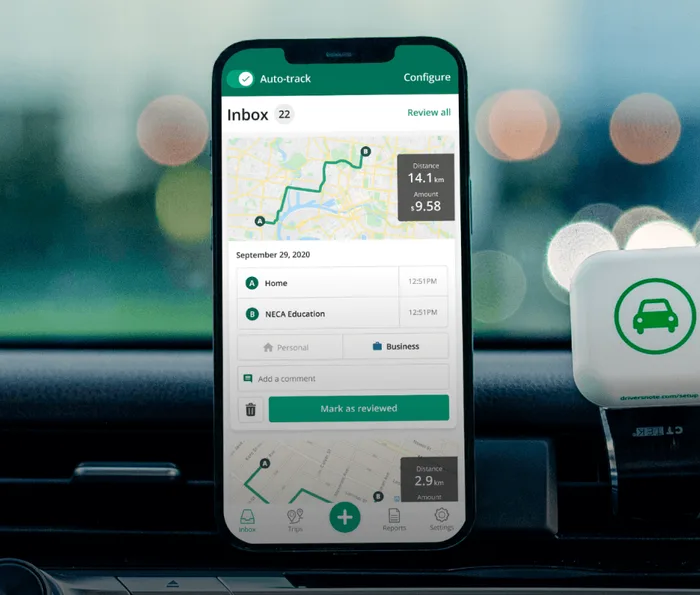
Keeping a logbook by hand is where most claims fall apart, because it’s easy to forget a trip or lose track of your business proportion. Driversnote tracks your business kilometres automatically in the background, logging the date, route, and distance of every trip. You classify each one as business or private with one tap.
When it’s time to claim or submit for reimbursement, you generate an IRD-compliant report in seconds, with your business and private kilometres already separated. That means the numbers you put into a calculator like this one are accurate, and the record behind them holds up.
Start with an accurate logbook
The mileage calculator gives you a fast estimate of your IRD deduction or reimbursement, but the claim itself rests on your records. Work out your figure above, keep a complete logbook of your business trips, and use the rates that match the year your travel happened.
If you’d rather not track trips by hand, Driversnote records them automatically and turns them into an IRD-compliant report when you need it. Get started for free and take the guesswork out of your next claim.
This article is for general information only and does not constitute tax advice. If you have questions about your specific situation, consult a tax professional or visit ird.govt.nz.\
Tired of logging mileage by hand?
Effortless. IRS-compliant. Liberating.
 Auto-track trips
 Classify trips
 IRS compliant reports