Latest update: 7 August 2026 - 5 min read
Free Vehicle Log Book & Mileage Template NZ (IRD Rates Built In)
Keeping a vehicle log book is the part of claiming your driving that most people leave until the last minute. Trips get forgotten, the odometer readings go missing, and working out the IRD kilometre rate by hand is fiddly once your travel passes the 14,000 km mark.
Our free vehicle log book and mileage template with built in formulas fixes both problems. You record your trips as you go, and the template applies the 2025–2026 IRD kilometre rates for you automatically, including the Tier 1 and Tier 2 split that trips up most people doing the maths themselves. Choose your vehicle type, enter your kilometres, and it shows the figure you can claim as a deduction or ask your employer to reimburse.
Download the free vehicle log book and mileage template
The template is a single spreadsheet with a vehicle log book where you record each trip, and a clear summary that works out your claim, with an overview of the current kilometre rates. It opens in Google Sheets or Excel, so you can use it on your phone in the car or on desktop.
You don’t need to sign up or hand over an email address to use it. Make your own copy, delete the example rows, and start logging.
Easy built in formulas for automatic calculation
What makes it different from a blank log book is the calculation. A printed log book records your trips but leaves the maths to you. This one has the IRD kilometre rates built in and does the two-tier split automatically, so the number you see is the number you can actually claim.
What your vehicle log book needs to record
IRD expects a record of your business travel kept at or near the time each trip happens. Working your kilometres out from memory at the end of the year isn’t accepted, so the template is set up to capture exactly what a compliant log book needs.
What each trip record must contain
For every business trip, the template records the date, where you drove from and to, the business reason, and the distance. These are the details IRD looks for in a vehicle log book, and they’re what separates a claim that holds up from one that doesn’t.
The template also has columns for your odometer reading at the start and end of each trip. If you fill those in, the distance calculates itself. If you already know the distance, you can type it straight into the distance column instead. Either way works.
For the full checklist of what a compliant record needs, see our guide to IRD vehicle log book requirements.
How long you need to keep a log book
You keep a log book for a test period of at least 90 consecutive days. That period establishes your business-use percentage, which is the share of your total driving that relates to earning your income.
Once you’ve worked out that percentage, you can use it for up to three years, as long as your pattern of business use doesn’t change by more than 20 percent. If it does, you start a fresh 90-day log book. Keep your records for seven years in case IRD asks to see them.
How to fill out your vehicle log book template
Choosing your vehicle type
At the top of the sheet, pick your vehicle type from the dropdown: petrol, diesel, petrol hybrid, or electric. This tells the template which IRD rate to apply, because the rate is different for each fuel type.
You only set this once. From there, every calculation in the Summary uses the correct rate for your vehicle.
Where your numbers appear
As you enter trips and mark each one as business or private, the template keeps a running total of your business kilometres. In the Summary you’ll see your business kilometres, your total kilometres, your business-use percentage, and your estimated claim in dollars.
The yellow cells are the only ones you fill in. Everything calculates on its own, so there’s nothing to break if you’re careful to leave the formula cells alone.
How does the template calculate my IRD claim?
The template uses the kilometre rate method, which is the approach IRD sets out for claiming business vehicle travel. It multiplies your business kilometres by the rate for your vehicle type, then adjusts for the 14,000 km threshold.
That threshold is where most manual calculations go wrong. The Tier 1 rate applies to the business portion of the first 14,000 kilometres your vehicle travels in the income year. Once the vehicle passes 14,000 kilometres in total, both business and private, the lower Tier 2 rate applies to the business portion above that.
Say you drive a petrol vehicle 18,000 kilometres in a year, of which 11,000 are for business. Your business-use share is around 61 percent. The template applies Tier 1 to the first 14,000 kilometres and Tier 2 to the remaining 4,000, giving a claim of about $11,171. You don’t run any of that by hand. The template splits the tiers and applies your business proportion for you.
If your total travel stays at or below 14,000 kilometres, there’s no split. The Tier 1 rate applies to all your business kilometres, and the template simply multiplies the two.
IRD kilometre rates for 2025–2026
The rates depend on your vehicle type and split into two tiers. IRD published the 2025–2026 rates on 3 June 2026, and they’re built into the template.
| Vehicle type | Tier 1 rate per km | Tier 2 rate per km |
| Petrol | $1.20 | 37 cents |
| Diesel | $1.30 | 38 cents |
| Petrol hybrid | 90 cents | 24 cents |
| Electric | $1.22 | 23 cents |
Tier 1 is higher because it covers both the fixed costs of owning your vehicle, such as insurance, registration, and depreciation, and the running costs like fuel and maintenance. Tier 2 is lower because it reflects running costs only.
You can see the figures and last year’s rates in our overview of the IRD kilometre rates for 2025–2026.
One point for employers: IRD has noted that because these rates are based on earlier costs and fuel prices have risen, the published figures may understate what running a vehicle costs right now. You can still use them, or use another method that gives a reasonable estimate of an employee’s costs.
Who can use the vehicle log book template
Both self-employed people and employees can use the template, and it works for teams too. The way you use the result is what changes.
Self-employed and sole traders
If you’re self-employed, a contractor, or run a small business, you claim the business portion of your vehicle costs as a deduction on your tax return. The kilometre rate method the template uses is the lighter option, because you only need a record of your business kilometres rather than every fuel and repair receipt.
You choose between the kilometre rate method and the cost method when you file. Our IRD mileage guide walks through both and helps you decide which suits your situation.
Employees claiming reimbursement
If you use your own car for work and your employer pays you back, the IRD rates act as a reasonable benchmark for reimbursement. A reimbursement that reflects your genuine business-use costs isn’t treated as taxable income.
Employers aren’t required to use the IRD rates exactly, but many do because they’re updated each year and simple to defend. Fill in the template, hand your employer the record of your business trips, and you have a clear basis for what you’re owed.
Teams and fleets
If you manage several drivers, a shared log book keeps everyone recording the same details in the same format, which makes approvals and reporting far quicker at tax time. The template gives each driver a consistent starting point, so you’re not chasing scraps of paper or piecing together kilometres from memory.
Digital mileage tracking
A template is a big step up from miscellaneous receipts, but it still relies on you remembering to log every trip. That’s where most claims quietly fall apart, because one forgotten drive throws out your business-use percentage for the whole period.
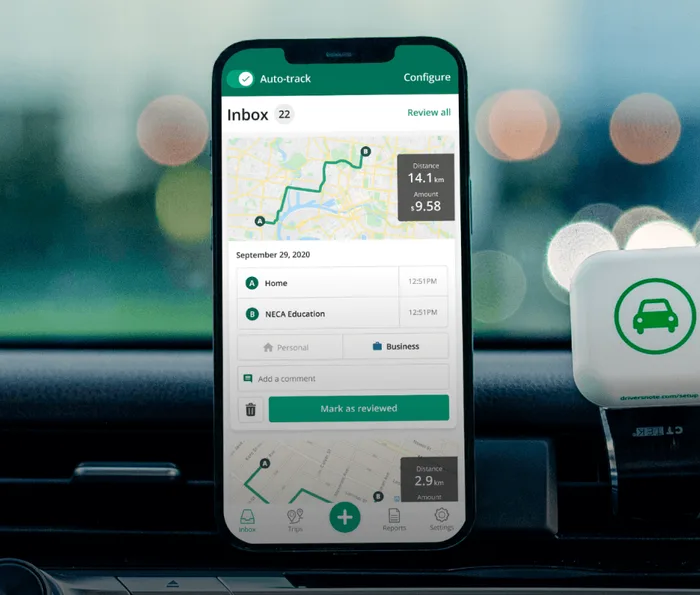
Driversnote tracks your business kilometres automatically in the background, recording the date, route, and distance of every trip. You classify each one as business or private with a single tap, so nothing slips through.
When it’s time to claim or submit for reimbursement, you generate an IRD-compliant report in seconds, with your business and private kilometres already separated and the rates applied.
Start with the free template above, and when the manual logging starts to wear thin, get started with Driversnote for free and let your log book keep itself.\
Tired of logging mileage by hand?
Effortless. IRS-compliant. Liberating.
 Auto-track trips
 Classify trips
 IRS compliant reports